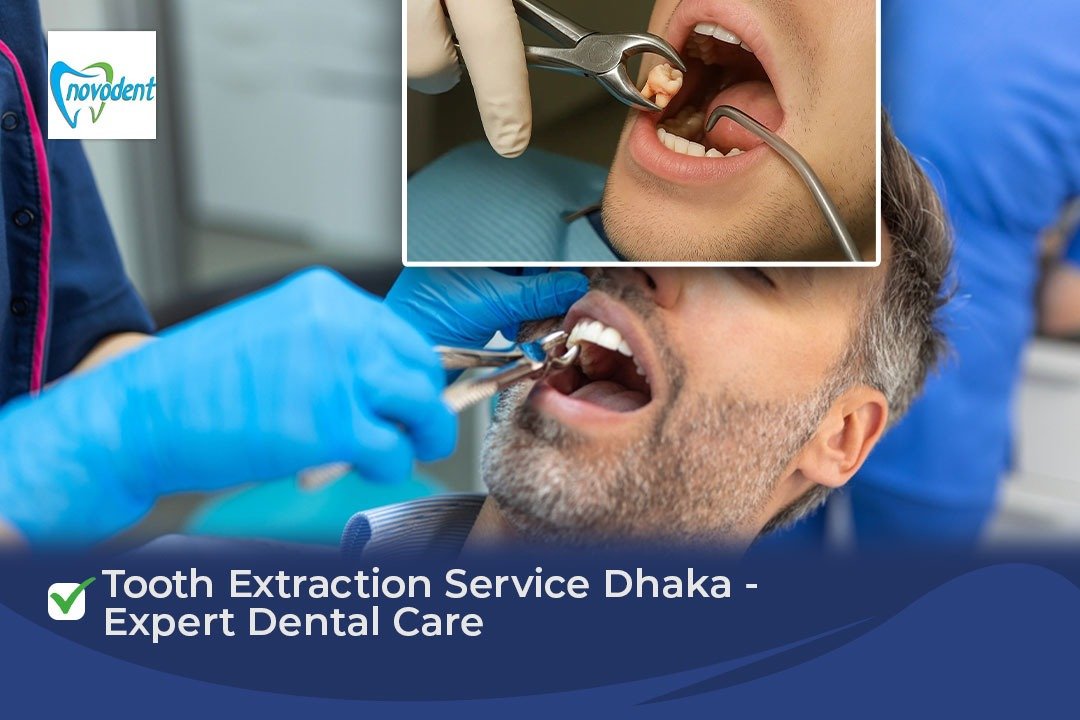

Are you suffering from severe tooth pain, a broken tooth, or an infected molar that just won't heal? You are not alone. Thousands of people in Dhaka face dental emergencies every day that require immediate tooth extraction. The good news is — Tooth Extraction Service Dhaka has never been safer, more painless, or more accessible than it is today at Novodent Dental Clinic.
At Novodent Dental Clinic, we understand that the thought of getting a tooth pulled can feel scary. That is why our experienced dental team uses the latest techniques, advanced anesthesia, and a gentle approach to make every extraction procedure as comfortable and stress-free as possible. Whether you need a simple extraction or a complex surgical removal, we have you covered.
In this complete guide, we will walk you through everything you need to know about tooth extraction — what it is, when you need it, how the procedure works, what risks exist, how to recover, and what options are available after your tooth is removed.
What Is Tooth Extraction?
Tooth extraction is the clinical removal of a tooth from its socket in the alveolar bone. It is one of the oldest and most commonly performed procedures in dentistry. While modern dentistry always aims to save a natural tooth whenever possible through fillings, root canals or crowns, there are situations where extraction is the only safe and effective solution.
There are two main categories of tooth extraction:
Simple Extraction — Performed on teeth that are fully visible above the gum line. The dentist loosens the tooth using an instrument called an elevator and then removes it with dental forceps. It is a quick and straightforward procedure done under local anesthesia.
Surgical Extraction — Required when a tooth is impacted, broken below the gum line, or has not fully erupted. The oral surgeon makes a small incision in the gum tissue to access the tooth. In some cases, the tooth is divided into sections for easier removal. This is most common for wisdom teeth.
At Novodent Dental Clinic, both types of extractions are performed by qualified and experienced dental surgeons using sterile, modern equipment in a fully hygienic environment.
Why Would You Need a Tooth Extraction?
Our dentists at Novodent always explore every possible way to save your natural tooth before recommending extraction. However, the following conditions typically require Tooth Extraction Service in Dhaka:
Severe Tooth Decay — When a cavity has progressed so deeply that it has destroyed the majority of the tooth structure and reached the pulp, and root canal treatment is no longer a viable option, extraction becomes necessary. Leaving a severely decayed tooth in the mouth can lead to spreading infection that affects surrounding teeth and jawbone.
Impacted Wisdom Teeth — Wisdom teeth, also called third molars, are the last teeth to erupt — usually between the ages of 17 and 25. In many people, there is not enough space in the jaw for these teeth to emerge properly. They become impacted, meaning they are trapped beneath the gum or grow at an angle. Impacted wisdom teeth cause pain, swelling, infection, damage to adjacent teeth, and cyst formation. Surgical extraction is the standard treatment.
Advanced Gum Disease (Periodontitis) — Severe periodontal disease destroys the bone and tissue that support your teeth. When the supporting structure is lost to a critical level, the tooth becomes loose and cannot be saved. Extraction prevents the infection from spreading further.
Broken or Fractured Teeth — A tooth that is cracked or broken below the gum line, especially after trauma or injury, often cannot be restored with a crown or other procedure. In such cases, extraction is the safest and most practical option.
Overcrowding for Orthodontic Treatment — In some orthodontic cases, particularly when the jaw is too small to accommodate all teeth properly, one or more teeth must be removed to create space for alignment. This allows braces or aligners to move teeth into their correct positions effectively.
Dental Abscess or Infection — A dental abscess is a pocket of pus caused by bacterial infection. If the infection has spread beyond the tooth and surrounding tissues and does not respond to antibiotics or root canal treatment, extraction may be required to eliminate the source of infection and prevent it from spreading to the jaw, neck, or brain in severe cases.
Baby Teeth That Have Not Fallen Out — Sometimes primary (baby) teeth do not fall out on their own, blocking the permanent teeth from emerging properly. In such cases, the dentist removes the baby tooth to allow normal development.
The Complete Tooth Extraction Procedure at Novodent Dental Clinic
Here is a detailed step-by-step breakdown of what happens during your tooth extraction service in Dhaka at Novodent:
Step 1 — Initial Consultation and Examination Your visit begins with a thorough dental examination. Our dentist will review your medical history, ask about any medications you are taking, and assess your overall oral health. It is important to inform us of any blood thinners, heart conditions, diabetes, or immune disorders, as these may affect the procedure and healing.
Step 2 — Digital X-Ray We take a digital X-ray of the affected tooth to evaluate the shape, length, and position of the roots, and the condition of the surrounding bone. This imaging helps our dentist plan the safest and most efficient extraction approach.
Step 3 — Anesthesia Administration Local anesthesia is injected into the gum tissue surrounding the tooth. Within a few minutes, the entire area becomes completely numb. You will feel pressure during the procedure but absolutely no pain. For highly anxious patients, we also offer sedation options upon request. We never begin any extraction until we are fully certain the area is numb.
Step 4 — Loosening the Tooth For simple extractions, the dentist uses a small instrument called a dental elevator to gently rock the tooth back and forth. This widens the socket and loosens the tooth from the ligaments holding it in place.
Step 5 — Removal Once the tooth is sufficiently loose, it is removed using dental forceps with a controlled rocking and pulling motion. For surgical extractions, the surgeon first makes a small incision in the gum. If necessary, some bone around the tooth may be gently removed, or the tooth may be sectioned into pieces before removal.
Step 6 — Socket Cleaning After the tooth is removed, the socket is cleaned and any bone fragments or infected tissue are removed. The area is then smoothed to promote proper healing.
Step 7 — Gauze Placement and Bleeding Control A clean gauze pad is placed over the socket and you are asked to bite down firmly. This pressure helps a blood clot to form, which is essential for healing. You will hold the gauze for approximately 30 to 45 minutes.
Step 8 — Sutures (if needed) In surgical extractions, the gum incision is closed with dissolvable stitches that do not need to be removed. For simple extractions, stitches are usually not required.
Step 9 — Post-Extraction Instructions Before you leave, our team provides you with a complete written and verbal guide on how to care for the extraction site at home, what medications to take, what to eat, and what warning signs to watch for.
Complications and Risks of Tooth Extraction
Like any medical procedure, tooth extraction carries some risks. However, serious complications are rare when the procedure is performed by a qualified professional like those at Novodent Dental Clinic. Being informed helps you recognize problems early.
Dry Socket (Alveolar Osteitis) — This is the most common complication after tooth extraction, occurring in about 2 to 5 percent of cases. It happens when the blood clot that forms in the socket is dislodged or dissolves too early, leaving the bone exposed. Symptoms include severe throbbing pain starting 2 to 4 days after extraction, bad breath, and an unpleasant taste. Treatment involves cleaning the socket and placing a medicated dressing. Smoking and using straws significantly increases the risk of dry socket.
Infection — Bacteria can enter the extraction site and cause infection. Signs include increasing pain, swelling, fever, and pus discharge. This is treated with antibiotics. At Novodent, we prescribe preventive antibiotics in high-risk cases.
Excessive Bleeding — Some bleeding is normal after extraction. Prolonged or heavy bleeding may occur in patients on blood thinners or with clotting disorders. It is important to inform your dentist of all medications before the procedure.
Nerve Injury — In rare cases, particularly during lower wisdom tooth extraction, nearby nerves can be affected, causing temporary or, very rarely, permanent numbness or tingling in the lip, chin, or tongue. Our surgeons use precise imaging and technique to minimize this risk.
Damage to Surrounding Teeth — Occasionally, crowns, fillings, or adjacent teeth may be affected during the extraction. Our careful approach and use of digital X-rays significantly reduces this possibility.
Jaw Fracture — Extremely rare, but can occur in elderly patients or those with very dense bone or severely impacted teeth. Our clinical assessment identifies high-risk cases in advance.
Pain Management and Anesthesia at Novodent
One of the biggest concerns patients have about tooth extraction service in Dhaka is pain. At Novodent Dental Clinic, pain management is our top priority.
We use high-quality local anesthetic agents to completely numb the extraction site before beginning any procedure. The injection itself may cause a brief sting, but once the anesthetic takes effect — usually within 2 to 5 minutes — you will feel no pain whatsoever during the extraction.
After the procedure, as the anesthetic wears off, you may experience mild to moderate discomfort, which is completely normal. We prescribe appropriate pain relief medication including NSAIDs (such as ibuprofen) and, when necessary, stronger analgesics. Most patients find their discomfort very manageable and return to normal activities within 1 to 2 days.
For patients with severe dental anxiety, we discuss additional options such as oral sedation to help them feel calm and relaxed throughout the procedure.
Detailed Recovery and Healing Timeline
Understanding what to expect during recovery helps you plan ahead and avoid complications.
First 24 Hours — This is the most critical period. A blood clot forms in the socket. Expect some bleeding, swelling, and mild to moderate pain. Rest completely. Apply ice packs to the cheek in 15-minute intervals. Eat only cold or room-temperature soft foods. Do not rinse, spit forcefully, or use a straw.
Day 2 and 3 — Swelling typically peaks on the second day and then begins to reduce. Pain should be decreasing with medication. You may notice slight bruising on the cheek — this is normal. Switch from ice to warm compresses after 48 hours. Begin gentle warm salt water rinses to keep the area clean.
Day 4 to 7 — Most patients feel significantly better. Soft tissue healing is well underway. You can begin eating slightly firmer foods. Any stitches placed will begin to dissolve. If you experience increasing pain rather than decreasing pain during this period, contact Novodent immediately as this may indicate dry socket or infection.
Week 2 — The gum tissue over the socket closes completely. Tenderness is minimal. You can return to a near-normal diet, though you should still avoid chewing directly on the extraction site.
One to Two Months — The deeper bone and tissue continue to heal and remodel. The socket fills in completely over several months. If you are planning a dental implant, this bone healing period is important.
What Are Your Options After Tooth Extraction?
Losing a tooth does not mean you have to live with a gap forever. At Novodent Dental Clinic, we offer several replacement options to restore your smile, chewing function, and confidence after tooth extraction service in Dhaka:
Dental Implant — The gold standard for tooth replacement. A titanium post is surgically placed into the jawbone to act as an artificial root, topped with a natural-looking crown. Implants are permanent, look and feel like real teeth, and prevent bone loss. Novodent offers full implant services.
Dental Bridge — A bridge uses the two adjacent teeth as anchors to hold an artificial tooth (pontic) in the gap. It is a fixed, non-removable option that restores appearance and function without surgery.
Removable Partial Denture — A removable appliance that replaces one or more missing teeth. It is the most affordable option but less comfortable and stable than implants or bridges.
Flexible Denture — A more comfortable and aesthetically pleasing version of the removable partial denture, made from a flexible thermoplastic material.
Our dentists at Novodent will discuss all these options with you and recommend the best solution based on your specific situation, budget, and oral health goals.
Wisdom Tooth Extraction — A Special Focus
Wisdom tooth extraction deserves special mention because it is one of the most frequently requested tooth extraction services in Dhaka at Novodent. Wisdom teeth are the four permanent adult teeth located at the back corners of the mouth. Most people develop them between ages 17 and 25.
When there is not enough room in the mouth, wisdom teeth become impacted — they may grow at an angle toward the next tooth, grow at an angle toward the back of the mouth, grow at a right angle as if lying down, or grow straight up or down but remain trapped within the jawbone.
Impacted wisdom teeth can cause significant problems including pain and jaw stiffness, swelling and infection around the gum flap, damage to the adjacent second molar, development of cysts or tumors in rare cases, and difficulty cleaning leading to decay.
At Novodent Dental Clinic, our surgeons are highly experienced in all types of wisdom tooth extraction — from straightforward to complex fully impacted cases. We use digital panoramic X-ray or CBCT scanning when necessary to map the exact position of the roots relative to the inferior alveolar nerve, ensuring maximum safety.
Why Novodent Dental Clinic Is the Best Choice for Tooth Extraction Service in Dhaka
Choosing the right dental clinic is just as important as the procedure itself. Here is why thousands of patients in Dhaka trust Novodent:
Our dentists hold advanced qualifications in oral surgery and have performed thousands of successful tooth extractions. We stay updated with the latest dental techniques and protocols. Our clinic is equipped with modern digital X-ray, surgical instruments, and sterilization systems meeting international standards. We maintain strict infection control with single-use instruments and autoclave sterilization for all reusable tools. Every patient receives a personalized treatment plan after thorough examination — we never rush a decision. We believe quality dental care should be accessible, so we offer fair and transparent pricing with no hidden fees. Our follow-up system ensures you are healing properly after your procedure, and our team is always available to answer your questions.
Frequently Asked Questions
How do I know if I need a tooth extraction or a root canal? Your dentist will assess the extent of damage or infection. If the tooth structure and roots are still viable, a root canal is preferred to save the natural tooth. If the damage is too extensive, extraction is recommended. At Novodent, we always try to save your teeth first.
How long does swelling last after tooth extraction? Swelling usually peaks at 48 hours and gradually reduces over 5 to 7 days. Applying ice during the first 24 hours and warm compresses after that helps manage swelling effectively.
Can I go to work the next day after extraction? For simple extractions, most patients return to desk work the next day. For surgical extractions like wisdom tooth removal, we recommend 2 to 3 days of rest.
What happens if I do not replace the extracted tooth? Missing teeth lead to bone loss in the jaw, shifting of adjacent teeth, changes in your bite, difficulty chewing, and changes in facial appearance over time. Replacement is strongly recommended.
Is tooth extraction safe for diabetic patients? Yes, with proper precautions. Diabetic patients must inform their dentist and ensure their blood sugar is well controlled before the procedure. We coordinate with your physician if necessary and may prescribe antibiotics to reduce infection risk.
Does Novodent Dental Clinic offer payment plans? Contact our front desk for information on current payment and installment options. We work to make our services accessible for all patients.
Book Your Appointment at Novodent Dental Clinic Today
Do not let tooth pain, infection, or a damaged tooth affect your quality of life any longer. Novodent Dental Clinic is your most trusted destination for professional Tooth Extraction Service Dhaka — combining clinical expertise, modern technology, and genuine patient care.
Whether you need an emergency extraction today or want to plan a procedure at your convenience, our team is ready to help. Contact Novodent Dental Clinic now to schedule your consultation and take the first step toward a healthier, pain-free smile.